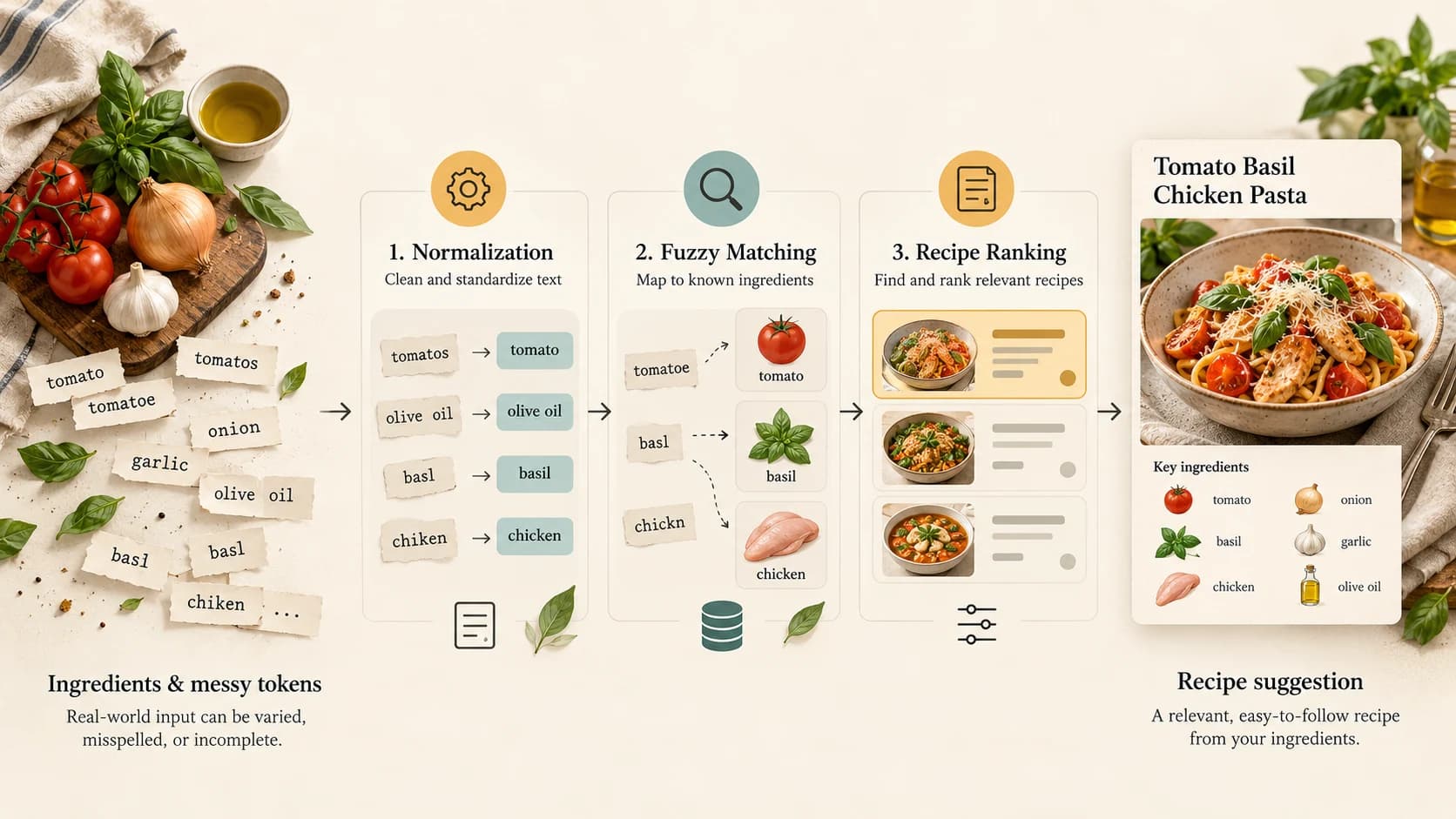
A simplified conceptual illustration of ingredient normalization and recipe recommendation. The examples illustrate processing stages rather than measured model outputs.
ChefMate: NLP + ML Pipeline from User Input to Recipe
ChefMate is an AI-powered recipe suggestion app I built as a solo developer.
Problem
Ingredient input is usually messy: spelling errors, synonyms, and inconsistent naming.
Pipeline
Normalize ingredients with spaCy
Handle input variation with FuzzyWuzzy
Predict cuisine and recipe candidates with scikit-learn
Return filtered suggestions through a Flask app
Dataset
I trained models using a 643MB recipe dataset and focused heavily on preprocessing quality.
Result
The NLP + fuzzy matching pipeline improved ingredient recognition by around 70% on noisy input scenarios.
Takeaway
For practical ML products, input normalization often drives quality more than model complexity.