Neuro-Symbolic AI: Why the Next Real Step Isn't a Bigger Model
Neuro-Symbolic AI: Why the Next Real Step Isn't a Bigger Model
For most of the last decade, progress in AI had one simple recipe: more data, more parameters, more compute. It worked far better than anyone had a right to expect. But if you have spent real time with these models, you have also felt the ceiling. A system writes a working REST API and then insists that 9.11 is larger than 9.9. It summarises a research paper and quietly invents a citation that does not exist. The pattern-matching is extraordinary. The reasoning is not reliable.
Neuro-symbolic AI is the most serious attempt to fix that, and it is older and more practical than the recent wave of hype suggests.
Two halves of one brain
There have always been two cultures in AI.
The symbolic tradition, sometimes called GOFAI ("good old-fashioned AI"), represents knowledge explicitly: rules, logic, graphs, programs. Tell it that all humans are mortal and that Socrates is human, and it can prove that Socrates is mortal, showing you every step on the way. Symbolic systems are precise, interpretable, and verifiable. Their weakness is that they are brittle. They do not learn from raw, messy data, and they fall apart the moment reality stops matching the schema.
The connectionist tradition, neural networks, does the opposite. It learns directly from examples, handles noise and ambiguity gracefully, and scales beautifully. That is the engine behind modern vision and language. Its weakness is the mirror image of the symbolic one: no explicit notion of a rule, no guarantee of consistency, no built-in way to explain why. It interpolates. Push it past the distribution it was trained on and it does not fail loudly; it confabulates with total confidence.
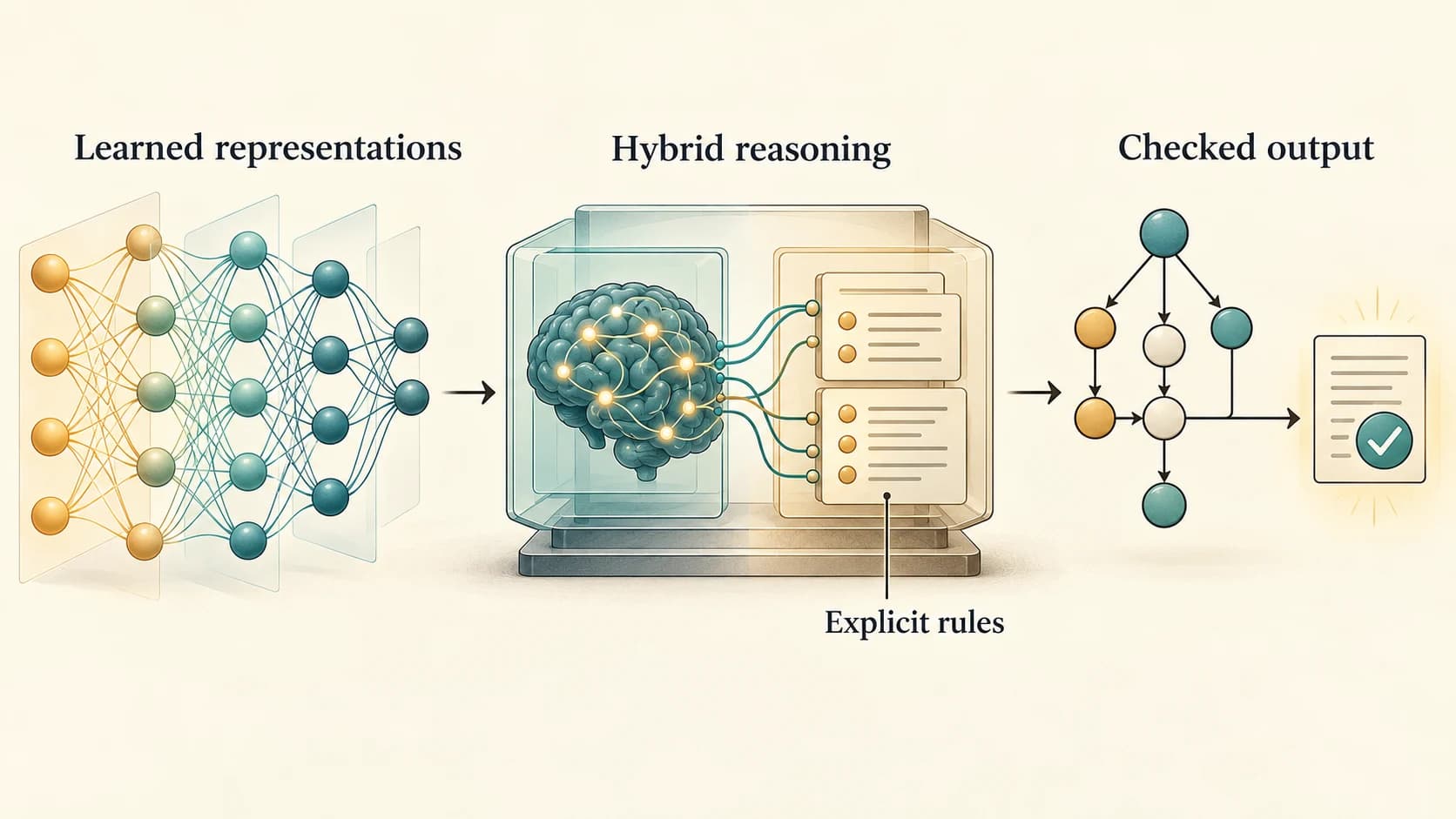
Neuro-symbolic AI is the bet that these are not rival religions but two halves of one brain. You want the perception and learning of neural networks and the structure and guarantees of symbols, working in a single system.
A map of the territory
The phrase covers a surprisingly wide range of architectures. Henry Kautz gave the field a useful taxonomy in his 2020 AAAI lecture, "The Third AI Summer," laying out six distinct ways to combine the two paradigms (AI Magazine). You do not need all six, but three patterns capture most working systems:
- Neural in, symbolic out. A neural network handles perception, then hands clean symbols to a reasoning engine. A vision model turns an image into objects and relations, and a logic program queries them.
- Symbolic skeleton, neural muscle. A classical search or planning algorithm provides the backbone, and a neural network supplies the expensive intuition: which move looks promising, which branch is worth exploring.
- Neural engine that calls symbolic tools. A learned model decides when to invoke an exact external procedure, a calculator, a database, a theorem prover, and folds the result back into its answer.
The interesting part is that the most impressive recent systems built this way are not research toys. They are concrete, and they win.
Three systems that actually work
AlphaGo and AlphaZero. The system that beat Lee Sedol was already neuro-symbolic, even if nobody marketed it with that word. Monte Carlo Tree Search is a textbook symbolic search procedure; the neural networks simply told the search where to look and how good a position was. Neither component could have done it alone. Search without intuition is too slow; intuition without search is too shallow.
The Neuro-Symbolic Concept Learner. A 2019 system from MIT and IBM answered questions about images by splitting the job in two: a neural network perceived objects and their attributes, and a symbolic program executor ran the actual logic of the question, such as "how many red cubes are left of the sphere?" (Mao et al., ICLR 2019). Because the reasoning stayed symbolic, the system generalised to new question types from very little data, and you could read off exactly what it did.
AlphaGeometry. This is the example I point to when someone tells me symbols are dead. In 2024, DeepMind published a system that solves International Mathematical Olympiad geometry problems at close to gold-medalist level (Nature, 2024; DeepMind write-up). The architecture is unapologetically hybrid: a symbolic deduction engine grinds through everything that follows logically from the diagram, and when it stalls, a language model proposes a clever auxiliary construction, the creative leap that pure logic search cannot find efficiently. Language model for intuition, symbolic engine for proof. The proofs it outputs are checkable, line by line. You do not get that from a chatbot, however large.
LLMs are already drifting toward symbols
Here is the part people miss. The most popular fix for LLM unreliability is itself a quiet neuro-symbolic move. The moment you let a model call a Python interpreter, run a SQL query, or hand a sub-problem to a real solver, you have built a system where the neural part handles language and intent and an exact symbolic part handles the steps that must be correct.
Asking a model to do long arithmetic in its head is asking the wrong organ to do the job. Letting it write and run code is letting the symbolic half do what it is good at. Retrieval-augmented generation is the same idea applied to facts: keep the knowledge in an external, inspectable store instead of smearing it across billions of weights. The next post on this blog, on the "reversal curse," is a sharp argument for exactly why you should be careful trusting those weights as a database.
Why this is genuinely hard
I do not want to sell a clean story. Stitching the two paradigms together runs into a real wall: neural networks live in a smooth, differentiable, continuous world, and symbols are discrete. Gradient descent does not flow naturally through a hard logical decision. A large fraction of neuro-symbolic research is, underneath, a fight over how to make discrete reasoning differentiable enough to train end to end without losing the guarantees that made symbols attractive in the first place.
And when you do bolt on a symbolic component, you can re-import its old brittleness. A reasoning engine is only as good as the symbols it receives. If the neural front-end mislabels the scene, the logic will reason flawlessly about the wrong world.
So this is not a solved problem. It is a direction, and the evidence that the direction is right keeps arriving as systems that do things scaling alone has not delivered.
Why I care about this
My own research is on detecting hallucinations in multi-document summarization: working out when a generated summary asserts something the sources never actually support. The most promising angle is not "train a bigger judge." It is to extract structured claims from the text and check them against structured evidence, a small symbolic consistency layer sitting on top of a neural generator. That is neuro-symbolic thinking in miniature, and it is why I think this is one of the most practical corners of AI to be working in right now.
The lesson I keep returning to is unglamorous. We do not need one architecture that does everything. We need to stop asking a single mechanism to be both a poet and an accountant.
Further reading
- Henry Kautz, The Third AI Summer (AAAI 2020 lecture) — the taxonomy this post leans on.
- Garcez and Lamb, Neurosymbolic AI: The 3rd Wave (2020).
- Mao et al., The Neuro-Symbolic Concept Learner (ICLR 2019).
- Trinh et al., Solving olympiad geometry without human demonstrations (Nature, 2024) — AlphaGeometry.
- Gary Marcus, The Next Decade in AI (2020) — the strongest case that scaling alone is not enough.