ConvoVerse
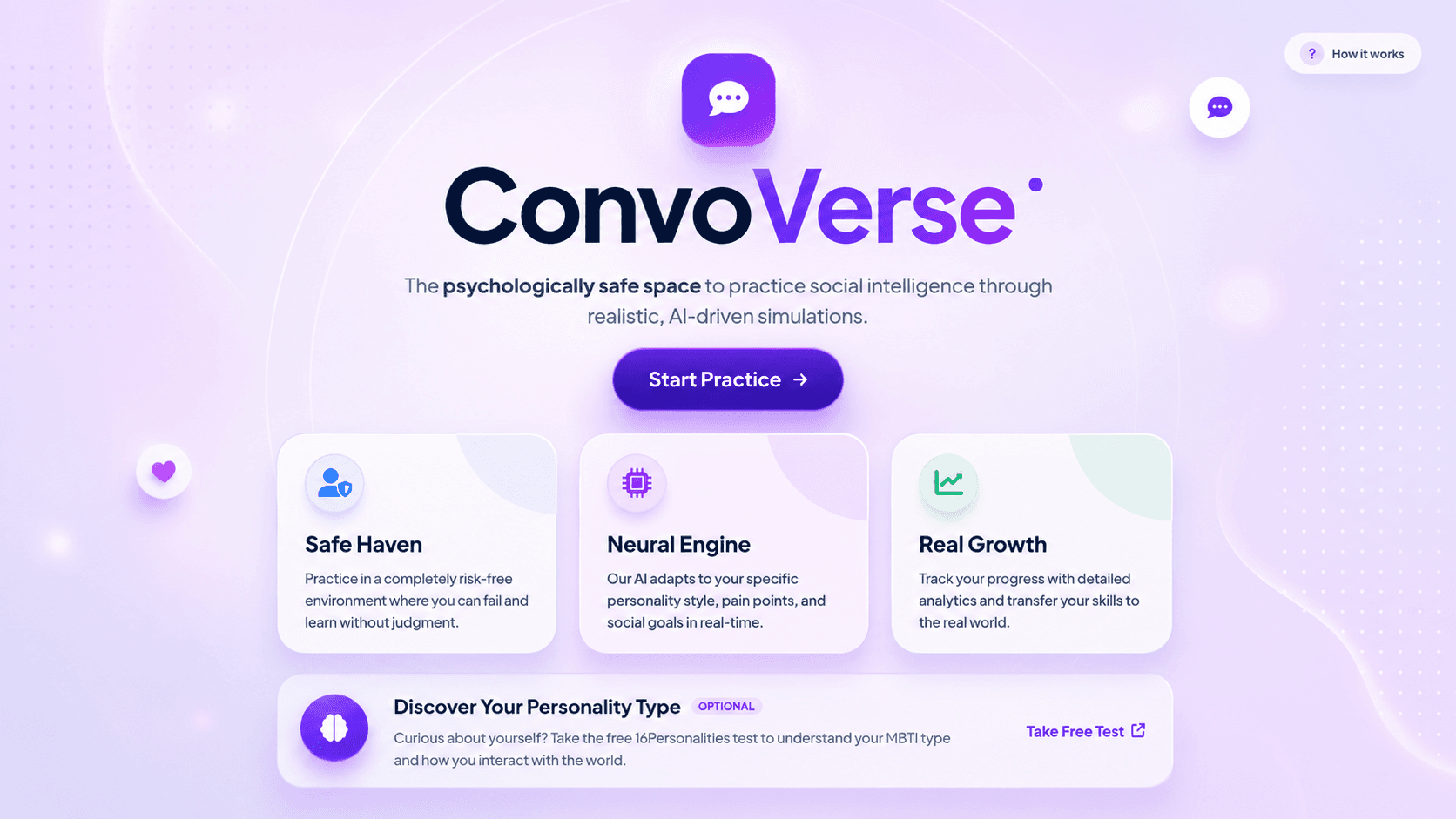
An academic Human-Computer Interaction project built on a specific claim: many capable students stay quiet not from lack of knowledge but from lack of rehearsal. ConvoVerse gives them a private space to practise, positioning AI as a facilitator that helps someone feel ready to participate — explicitly not as a substitute for talking to people.
The Problem
Educational platforms optimise for delivering content and assume participation follows. For students who freeze in discussions, the barrier is social readiness, and every existing option asks them to practise in exactly the public setting they are avoiding.
The Solution
Difficulty is scaffolded in stages instead of thrown at the user. Observer Mode lets them watch agents converse without participating; then one-on-one with a single peer agent; then a small group where a Peer, a Group Member, and a Facilitator compete for turns. Rewind and Retry lets any exchange be restarted with no penalty.
System Architecture
The same agent roles are recombined per stage rather than rewritten, so escalating difficulty is a matter of how many agents are present and how they interact. Psychological safety is enforced as a design constraint: no scoring, no public exposure, no forced turn — closing feedback is reflective rather than evaluative.
Key Features
Innovative solutions developed to solve complex technical challenges.
Observer Mode
The user watches AI agents hold a conversation with no expectation of input, so the first exposure carries no risk of being addressed.
Three distinct agent roles
A Peer converses as an equal, a Group Member competes for speaking turns, and a Facilitator keeps discussion moving — together modelling the dynamics that make group settings hard.
Rewind and Retry
Any exchange can be restarted to try a different response, making exploration free and removing the cost of saying the wrong thing.
Adaptive pacing
Conversation speed and complexity respond to the user's comfort rather than following a fixed script.
Non-evaluative reflection
Sessions close with reflective prompts rather than a score, keeping the experience about confidence instead of performance.
Challenges & Breakthroughs
Challenge: An AI conversation partner risks becoming a substitute for human contact — the opposite of the intended outcome.
Growth: Framed every interaction as rehearsal for a real conversation rather than a replacement, and made the staging always point outward toward participation. The framing is the intervention here; the same agents with different framing would produce a different, worse product.
Challenge: Scoring is the obvious way to show progress, and exactly the wrong mechanic for anxious users.
Growth: Dropped scores entirely in favour of reflective prompts. Any evaluative signal reintroduces the judgement the environment exists to remove, so the safety property has to be enforced by leaving features out.
Results & Impact
Next Project
Care Companion